In today’s fast growing world of AI and content creation, understanding the prompting hierarchy can make a huge difference in the quality of your results.
Whether you’re using AI tools for writing, coding, design, or business tasks, the way you structure your prompts directly impacts what you get in return.
A well organized prompting hierarchy helps you communicate clearly with AI systems, ensuring your instructions are followed accurately and efficiently.
Instead of giving random or unclear commands, a structured approach allows you to guide AI step by step from general context to specific instructions.
This not only improves output quality but also saves time and reduces frustration. Think of it like giving directions: the clearer and more organized they are, the better the outcome.
In this guide, we’ll break down everything you need to know about prompting hierarchy from basics to advanced strategies so you can get smarter, faster, and more reliable results from AI tools.
What Is Prompting Hierarchy?

- 🧠 It refers to structuring prompts in levels of importance
- 📊 Helps AI understand context before details
- 🪜 Works like a top-down instruction system
- 📌 Starts with general instructions, then narrows down
- 🎯 Improves clarity and output accuracy
- 💡 Reduces confusion in complex tasks
- 🧩 Breaks big tasks into smaller steps
- ⚡ Enhances efficiency in AI responses
- 🔍 Makes prompts more precise and targeted
- 🛠️ Useful in writing, coding, and automation
- 📈 Boosts productivity with AI tools
- 🔄 Allows easier editing and refinement
Why Prompting Hierarchy Matters
- 🚀 Leads to better AI-generated results
- 🧾 Reduces the need for repeated prompts
- ⏱️ Saves time and effort
- 🎯 Ensures instructions are followed correctly
- 🤖 Helps AI prioritize key instructions
- 📚 Improves learning and understanding of AI behavior
- 💬 Makes communication with AI smoother
- 🔧 Helps in troubleshooting outputs
- 🧠 Supports complex problem-solving
- 📊 Increases consistency in results
- 🪄 Makes outputs more human-like
- 📌 Essential for professional use cases
Key Levels in a Prompting Hierarchy
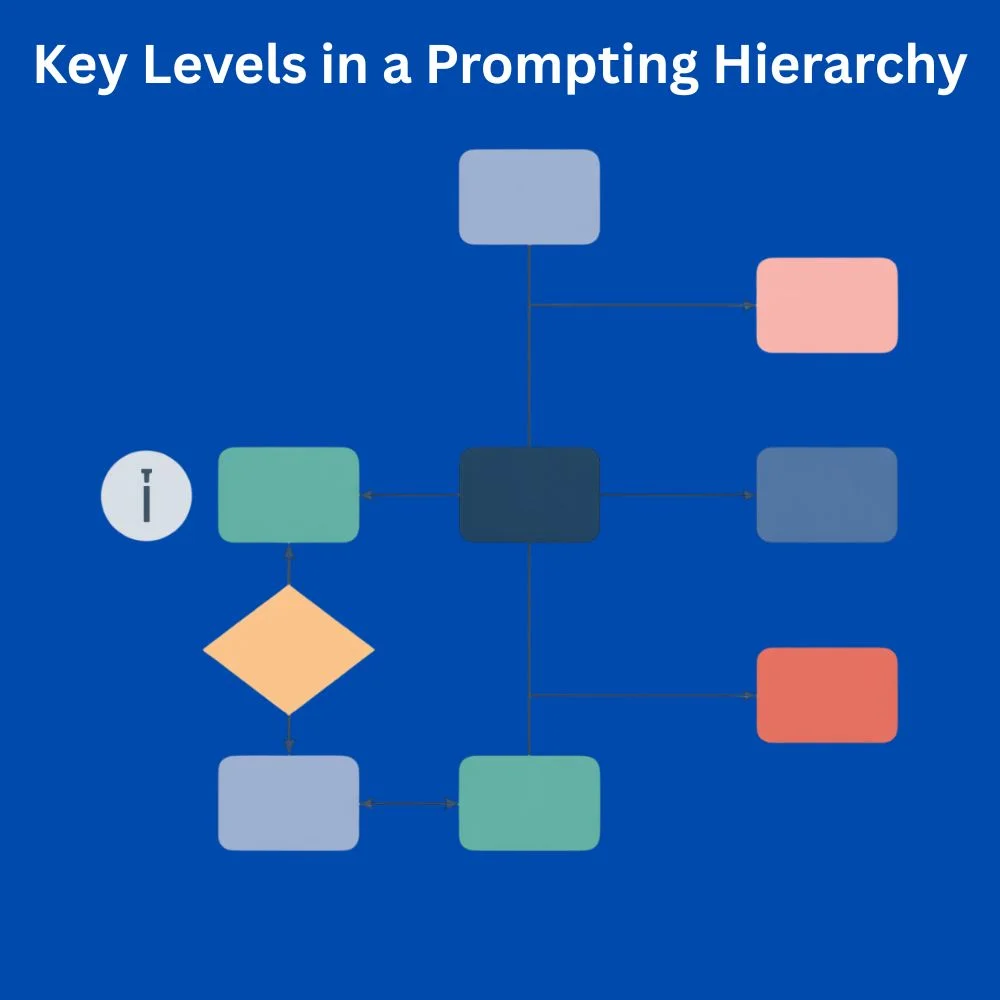
- 🏗️ Primary instruction (main goal)
- 📖 Context setting (background info)
- 📝 Detailed instructions (specific steps)
- 🎨 Tone and style guidance
- 📏 Constraints and limits
- 🔄 Examples for clarity
- 📌 Formatting instructions
- 🧪 Testing or validation steps
- 🔍 Refinement layer
- 🧠 Optional advanced conditions
- ⚙️ Helps structure complex prompts
- 📊 Improves logical flow
Basic Structure of an Effective Prompt
- 🧾 Start with a clear objective
- 📖 Add relevant context
- 🛠️ Include specific instructions
- 🎯 Define expected output format
- 🗣️ Mention tone (formal, casual, etc.)
- 📏 Set limits (word count, style rules)
- 🔄 Add examples if needed
- 📌 Keep instructions organized
- 🧠 Avoid vague language
- ⚡ Use simple and direct wording
- 🔍 Review before submitting
- ✏️ Edit and refine for clarity
Common Mistakes in Prompting Hierarchy
- ❌ Giving unclear instructions
- ❌ Skipping context entirely
- ❌ Overloading with unnecessary details
- ❌ Mixing multiple tasks in one prompt
- ❌ Ignoring formatting instructions
- ❌ Not specifying tone or audience
- ❌ Using vague or ambiguous language
- ❌ Repeating the same keyword excessively
- ❌ Forgetting output constraints
- ❌ Not testing or refining prompts
- ❌ Assuming AI understands everything
- ❌ Lack of structure in prompts
How to Build a Strong Prompting Framework
- 🏗️ Start with a clear goal
- 📖 Add structured background information
- 🧩 Break tasks into steps
- 🎯 Define expected outcomes
- 📏 Set boundaries and rules
- 🗣️ Choose tone and style
- 🔄 Include examples for guidance
- 🧪 Test different variations
- 🔍 Analyze and improve results
- 📊 Track what works best
- ⚡ Keep prompts concise
- 🛠️ Continuously refine your system
Prompting Hierarchy for Content Writing
- ✍️ Start with topic and goal
- 📖 Add target audience details
- 🎯 Define tone and style
- 🧾 Provide structure (headings, sections)
- 📏 Set word count limits
- 🔄 Include keyword guidance naturally
- 🧠 Avoid keyword stuffing
- 📌 Add formatting instructions
- 🗣️ Specify readability level
- 🔍 Request revisions if needed
- 📊 Optimize for SEO
- ⚡ Ensure engaging flow
Prompting Hierarchy for AI Tools and Automation
- 🤖 Define the automation goal
- 📖 Provide system context
- 🛠️ List step-by-step actions
- 🎯 Specify desired output
- 📏 Set conditions and triggers
- 🔄 Include fallback instructions
- 🧠 Add logical conditions
- 📌 Ensure clarity in commands
- ⚙️ Use structured formatting
- 🔍 Test outputs regularly
- 📊 Monitor performance
- 🚀 Improve efficiency over time
Advanced Prompting Techniques
- 🧠 Use multi-layered prompts
- 🔄 Apply iterative prompting
- 📊 Combine multiple instructions logically
- 🧪 Test variations for best results
- 🎯 Use role-based prompting (e.g., “act as”)
- 📖 Provide detailed examples
- ⚡ Use constraints effectively
- 🔍 Analyze AI responses
- 🛠️ Refine based on output
- 📌 Use conditional logic
- 🚀 Experiment with creativity levels
- 🧩 Optimize for complex tasks
Benefits of Using Prompting Hierarchy
- 🚀 Higher quality outputs
- ⏱️ Faster task completion
- 🧠 Better AI understanding
- 📊 Consistent results
- 🧾 Improved clarity
- 🔍 Easier troubleshooting
- 🎯 More precise responses
- 💡 Better creativity control
- 🛠️ Increased productivity
- 📌 Scalable workflows
- ⚡ Reduced errors
- 📈 Professional-level results
Real-World Use Cases of Prompting Hierarchy
- ✍️ Blog writing and SEO content
- 💼 Business reports and emails
- 🧑💻 Coding and debugging
- 🎨 Graphic design prompts
- 📊 Data analysis tasks
- 🛒 E-commerce product descriptions
- 📱 Social media content
- 🎓 Educational materials
- 🧠 Research assistance
- 🎯 Marketing campaigns
- ⚙️ Workflow automation
- 📌 Customer support scripts
Conclusion
Understanding and applying a structured prompting hierarchy can completely transform how you interact with AI tools.
Instead of relying on trial and error, you gain a clear, repeatable system that delivers better and more consistent results.
By organizing your prompts into logical layers starting with context and ending with specific instructions you make it easier for AI to understand exactly what you need.
This approach is especially valuable in professional environments where accuracy, clarity, and efficiency matter the most.
Whether you’re writing content, automating workflows, or solving complex problems, a well designed prompt structure ensures that your output meets expectations every time.
The key is to stay simple, clear, and intentional. Avoid overcomplicating your prompts, but also don’t leave out important details.
With practice, you’ll find the right balance and develop a system that works perfectly for your needs. Mastering this skill today can give you a strong advantage in the evolving world of AI.
Ready to take your AI skills to the next level? Start practicing your own prompting hierarchy today and see the difference in your results. Experiment, refine, and unlock the full power of AI—your smarter workflow starts now!

A passionate content writer specializing in SEO-driven blogs and digital storytelling. He helps brands grow with engaging and user-focused content.